
Three viewing areas, blended into one lens
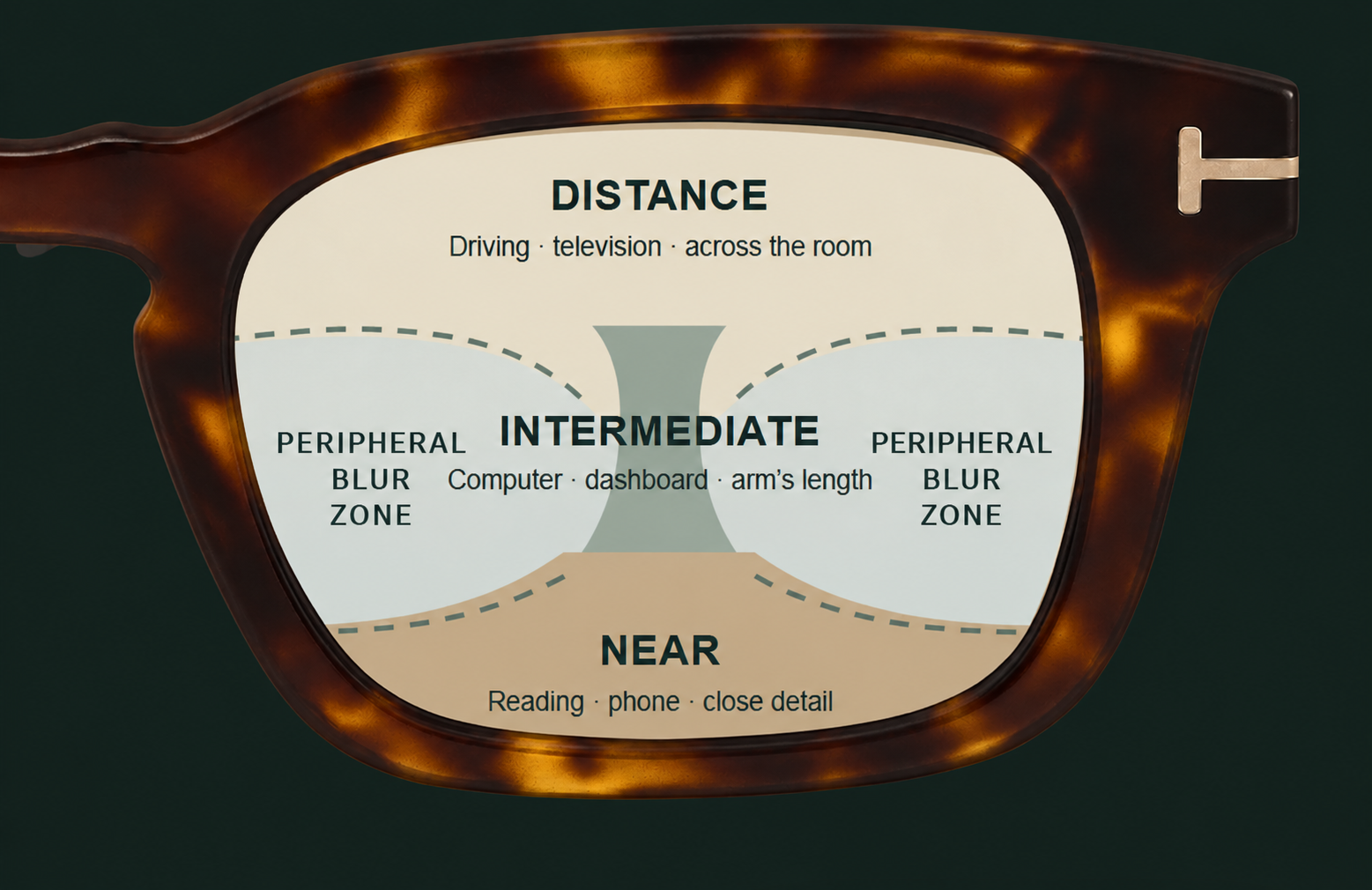
The upper portion of a progressive lens supports distance vision, the central corridor transitions through intermediate distances, and the lower portion provides near power for reading and close work. The prescription changes continuously between those areas, creating a smooth visual progression rather than separate segments.
Modern progressive designs can be selected around the way you work, drive, read and use devices. Frame choice, precise measurements and final adjustment help position each viewing area where your eyes can find it naturally.
Follow the hourglass.
The widest viewing area is used for distance. Power increases through the narrowing intermediate corridor, then opens into the near area at the bottom.
Distance vision at the top
The broad upper area supports looking across a room, watching television and seeing the road ahead. Accurate centering helps place the distance prescription naturally in front of each eye.
Intermediate vision through the corridor
Power changes gradually through the central hourglass-shaped corridor. This is the area commonly used for dashboards, computer screens, counters and other arm's-length tasks.
Near vision at the bottom
The lower portion provides the additional power used for reading, phones and close detail. The size and position of this area vary with the selected design, prescription and frame.
Frame choice supports the design
A well-chosen frame provides useful vertical space, sits consistently and keeps the viewing areas positioned correctly while still expressing the wearer's style.
Measurements make the design personal
Monocular pupil distance, fitting height and frame adjustment help align the viewing corridor for each eye. Accurate measurements help place the lens design where your eyes naturally use it.
Advanced digital measurements
Our digital measuring devices record how your selected frame actually sits on your face. In addition to monocular pupil distance and fitting height, they can capture pantoscopic tilt, frame wrap and the lens-to-eye distance used by the new customized digital progressive designs.
At a glance
- Distance, intermediate and near correction without a visible line
- Progressive designs selected around your daily visual demands
- Frame dimensions that support the desired viewing areas
- Accurate monocular pupil distance and fitting-height measurements
- Lens material and treatments matched to the prescription
- Professional fitting, guidance and follow-up adjustments
Good questions deserve clear answers.
Do progressive glasses work at every distance?
They provide zones for distance, intermediate and near correction, but each zone has a defined position and width. Wearers learn to point their head and eyes through the appropriate area.
Are progressive lenses better than bifocals?
Not automatically. Progressives avoid a visible segment line and add intermediate vision, while lined bifocals provide clearly separated zones. The better choice depends on tasks, preferences and adaptation.
Will progressive lenses eliminate eye strain?
Not necessarily. Eye strain can have several causes, and a progressive design may not match every work distance. The prescription, lens design, frame fit and task should all be evaluated.
Can progressive lenses be Transitions lenses?
Often, yes, when the prescription, material and progressive design are compatible. Light-adaptive treatment is a separate option from the progressive design itself.